
Assisted Thinking
The Western media’s relentless greenwashing of China’s coal addiction.

“Truth is like the sun. You can shut it out for a time, but it ain’t goin’ away.” – Elvis Presley
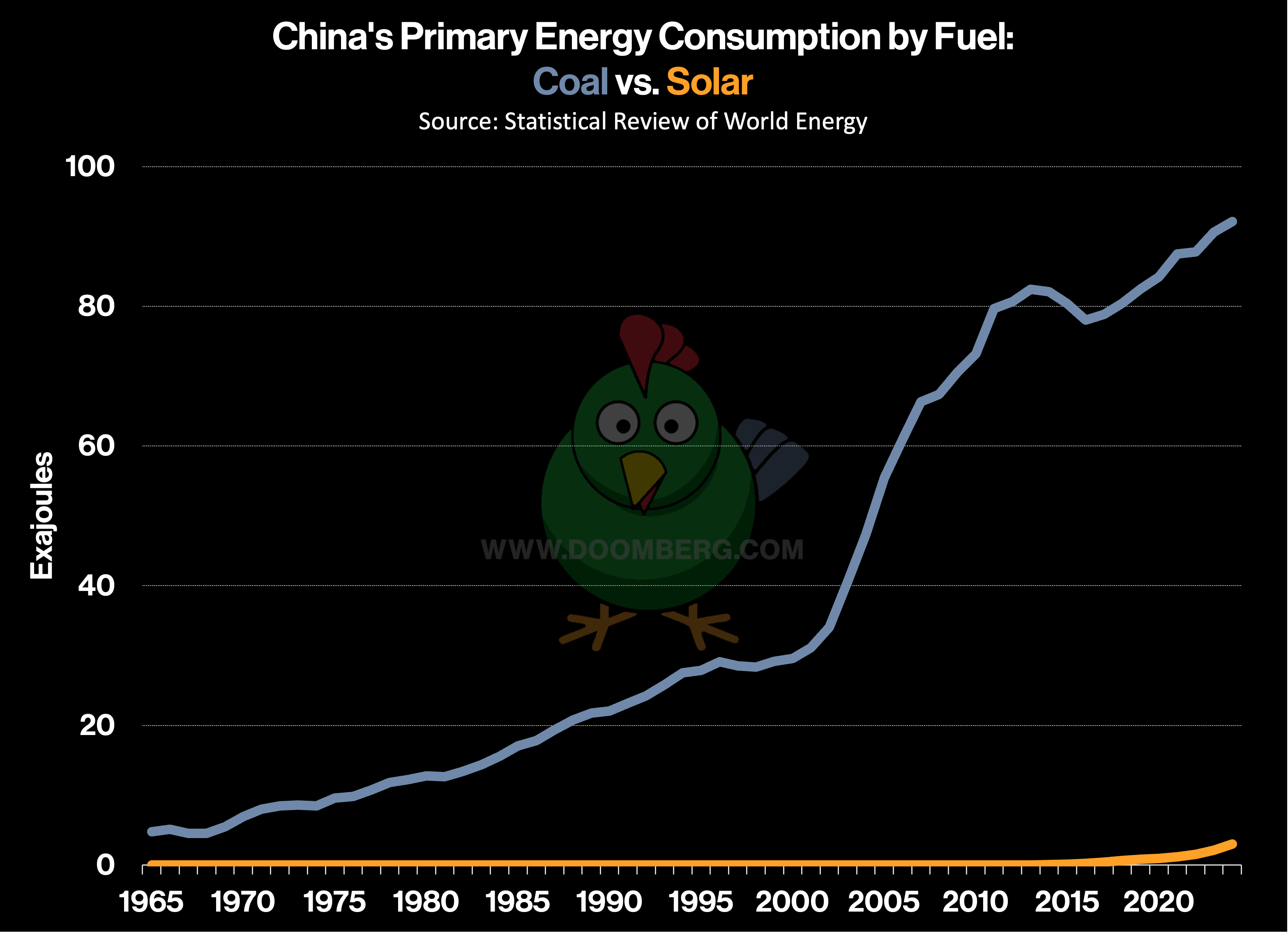
It is a firm, objective, and undeniable statement of fact that China’s economy is powered by coal. According to the latest data available from the Statistical Review of World Energy, coal accounted for 58% of the country’s primary energy consumption in 2024. A distant second was oil at 20%, with natural gas rounding out the podium at 10%. Simple arithmetic dictates that nuclear, hydroelectric, solar, wind, and other renewables split the remaining 12%.
China’s coal appetite is so ferocious that it alone burns 56% of the global total, or 20 times the current combined consumption of the 27-member states of the European Union (EU). Just since 2000, China has tripled the amount it burns, and that wedge of growth alone is some eight times larger than total US consumption in 2024.
Against this carbon-intense backdrop, legacy media outlets in the West regularly trip over themselves to heap praise on China’s bold climate leadership. We have long found this predisposition both bizarre and utterly detached from reality, part of what seems a purposeful distortion campaign. Perhaps unsurprisingly, the reappearance of Orangemanbad in the Oval Office has only accelerated the pace of these efforts.
Within days of each other in late September, The New York Times and The Washington Post published typical embodiments of the phenomenon, with articles titled “China’s Small Steps Look Bigger Next to Trump’s Retreat” and “China asserts green energy leadership, as Trump dismisses climate ‘con job’.” Our particular favorite hit the wires in early January, when Foreign Policy published an essay called “Can China Replace an Absent America in the Climate Fight?” Here’s a choice snippet:
“Interestingly, Chinese officials also never bought the argument maintained by some US politicians that reducing emissions would cause economic harm. To the contrary, they saw clean technology as an industry of the 21st century, and that is why, back in 2010, the Chinese government designated ‘new energy,’ ‘new-energy vehicles,’ and ‘energy-efficient and emerging technologies’ as three of its seven strategic emerging industries.”
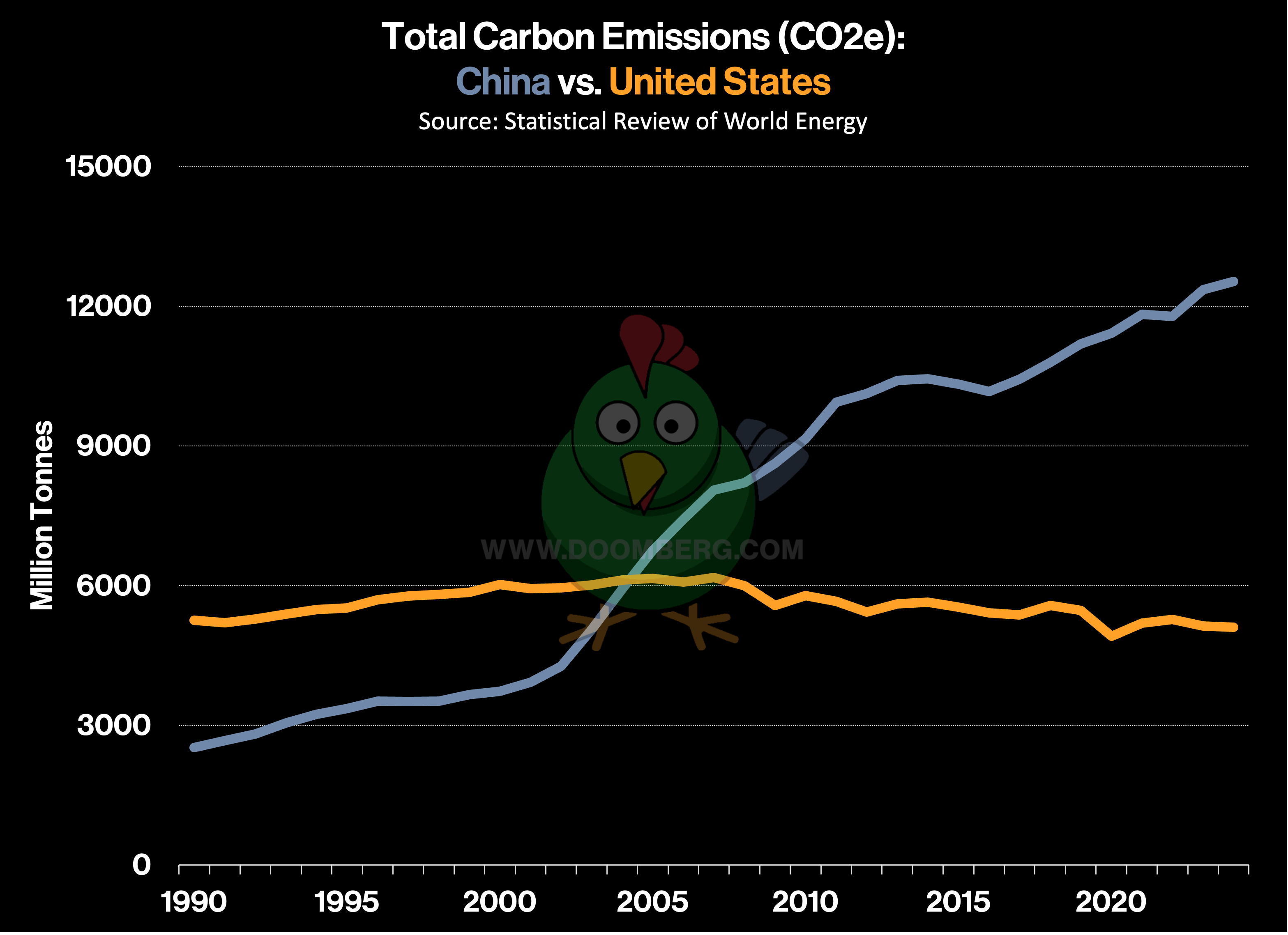
The entire thesis of the essay fails the most basic of tests. Of course, Chinese officials never bought the argument that reducing emissions would cause economic harm. They’ve been too busy increasing them:
Not all efforts at lauding China and renewable energy are as easy to dismiss as that one, however. In October, the British-based think tank Ember released its mid-year review of global electricity trends, an event that triggered a cascade of global headlines proclaiming the renewable energy revolution had achieved irreversible momentum. Among the leading claims published by Ember were that more electricity had been produced from renewable sources than coal worldwide in the first half of 2025; that new wind and solar production accounted for 109% of global electricity demand growth over the same period; and that “China’s leading clean energy growth” was a key driver of these trends.
What are we to make of these particular claims, and how can they be squared with the two charts published above? Do they bear any semblance to what’s actually happening in the real world, or are these mere statistical sleights of hand? Let’s unpack the methodology and reconcile the differences.