

“You proceed from a false assumption: I have no ego to bruise.” – Leonard Nimoy
What is the appropriate price of oil? Given a set of supply, demand, and inventory numbers, where should the world’s most important commodity trade? For obvious reasons, the war in Iran and the closure of the Strait of Hormuz have brought this question to the forefront of market analysis, and a digital avalanche of opinions on the subject now proliferates across social media. Depending on one’s viewpoint—or, perhaps more accurately, one’s level of experience in studying such matters—current action in the oil markets is either a logical reflection of the integral of market forces or the greatest conspiracy of price suppression in the history of finance. Determining which end of this thought curve is worthy of occupation motivates today’s missive.
One significant challenge is that the question itself involves an important bit of trickery, as there is, in fact, no singular price of oil. Absent the specification of grade, location, and especially timing of delivery, the price of a barrel of oil has no meaning, and yet market reporting necessitates a gross simplification of the matter.
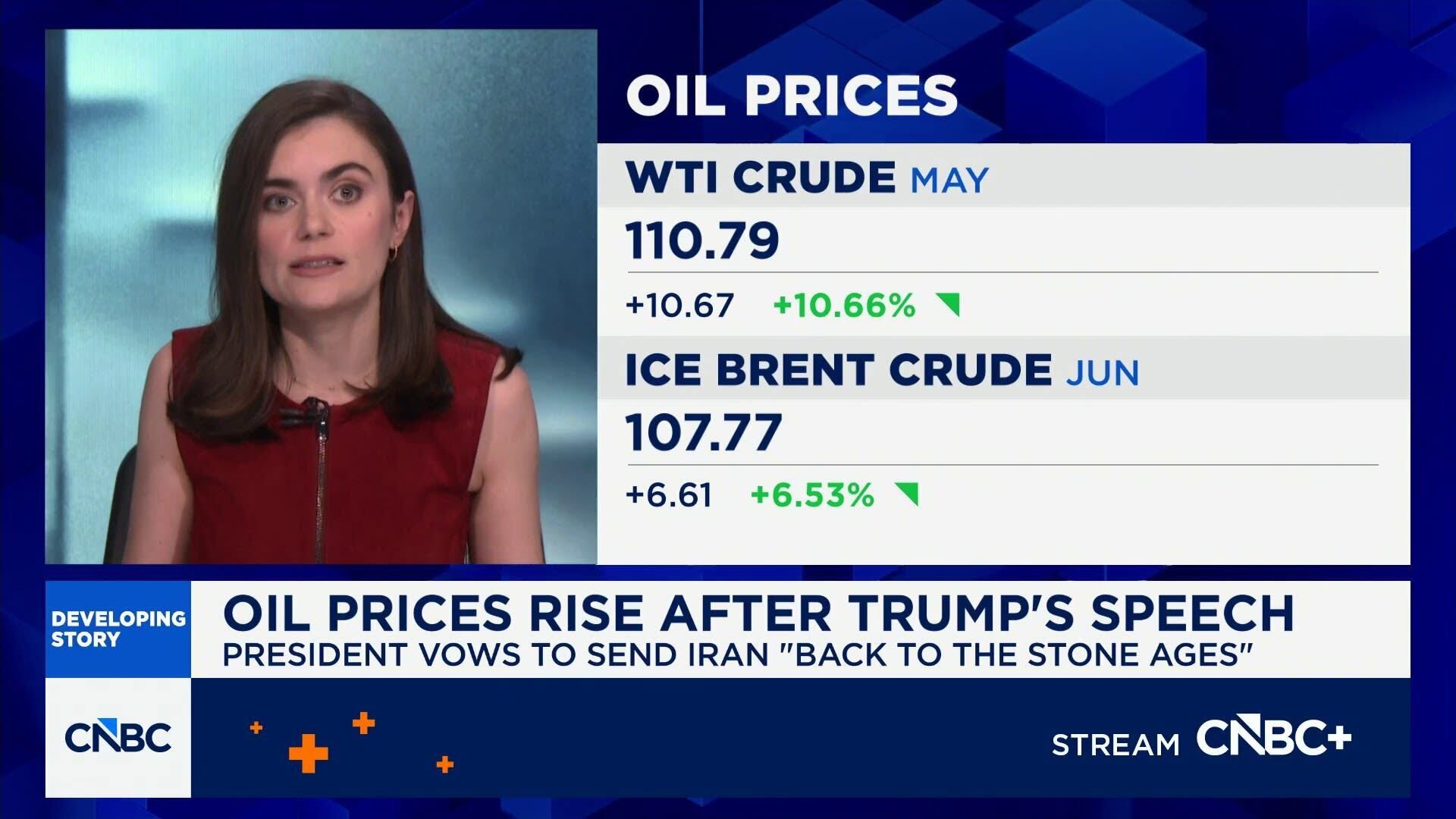
When quoting the price of oil in North America, commentators are almost always referring to the front-month futures contract for West Texas Intermediate (WTI) on NYMEX/CME, with physical delivery at Cushing, Oklahoma. When the rest of the world quotes the price of oil, they are most often referring to the front-month ICE Brent crude futures contract in Europe, which prices a large share of globally traded seaborne crude. To confuse matters further, because exchanges often use different expiry schedules—the mechanics of delivery are not universal, after all—the definition of “front month” is not itself standardized.
That billions of dollars are traded daily, incorporating a plethora of nuances, makes the oil markets no place for amateurs—one of many reasons you will not find us in the pits. We have far too much respect for our limited capital and for the expertise of those who do it for a living to be the fools at that particular poker table. That does not mean useful information cannot be gleaned from the market action, however, and there has been no shortage of fascinating and unexpected developments in this regard since the war broke out.
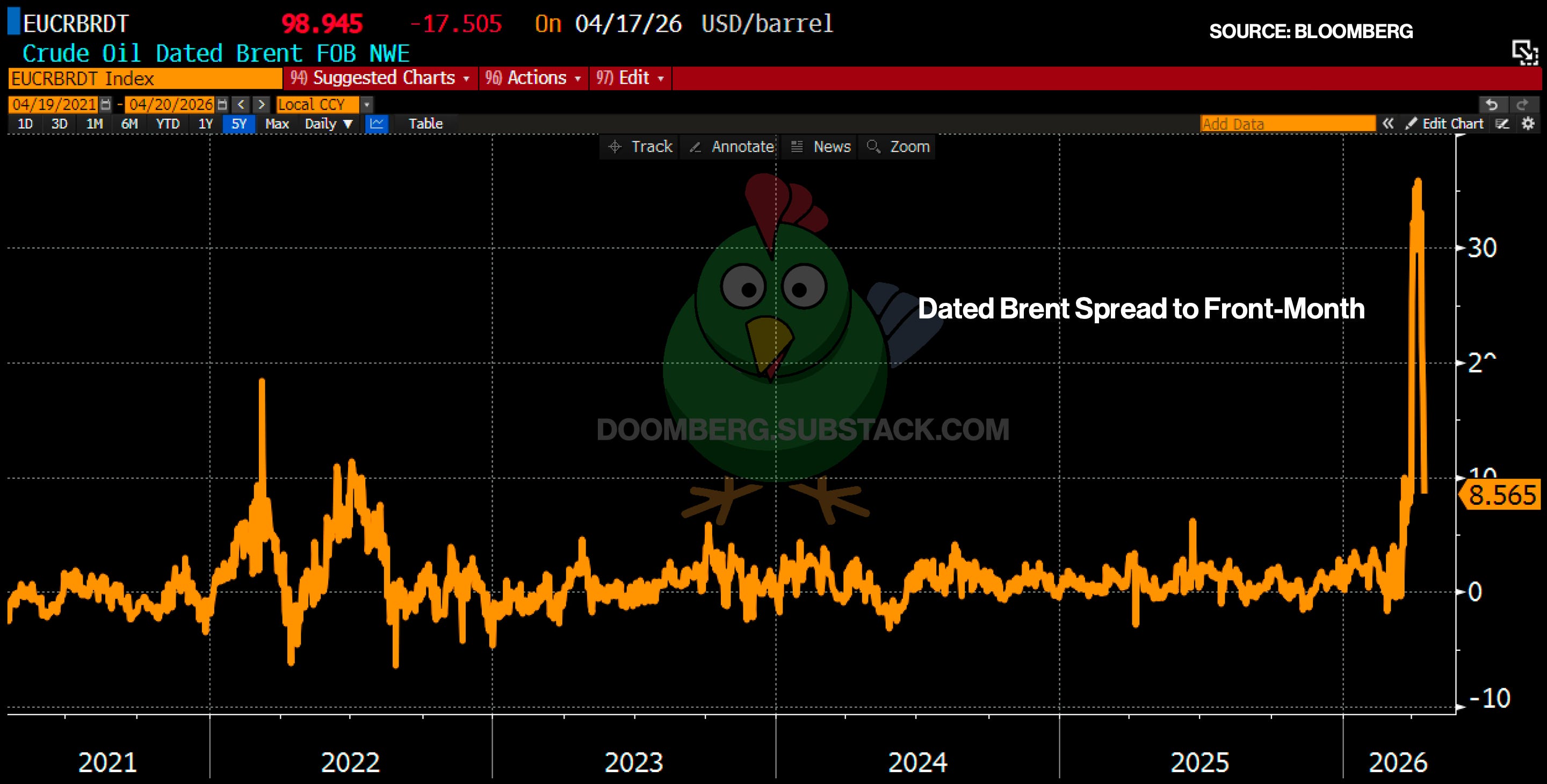
One development that caught attention in the Twitterverse is the extreme backwardation seen in global oil prices—a phenomenon in which oil that can be delivered sooner is priced higher than oil promised to arrive at a later date. That backwardation is a normal market response to shortages has been obscured by the sheer scale of what the Iran war has triggered and by how unfamiliar such behavior is to the cadre of newly minted expert oil traders on social media.
To visualize the phenomenon, consider the price spread between Dated Brent—oil with a delivery date attached to it and thus a proxy for spot prices—and its associated front-month contract. During normal times, this spread is minimal, but the Iran war pushed it to levels far exceeding those observed during the early weeks of the war in Ukraine:
To some, this price action is not normal, but instead is proof that the “real” price of oil is much higher than the “fake paper” prices “they” are allowing to print on our collective screens. There are many versions of this claim, but this particular one—sent our way by many subscribers, with several hundred thousand views at the time of writing—captures the essence:
“I’m watching the numbers flicker on the screen -- Brent crude at $92, WTI hovering near $97 -- and I feel a profound sense of dread. This isn’t a market; it’s a meticulously crafted fiction. We are being lied to on a scale so vast it defies comprehension. The current paper price for oil is a government-constructed lie, a narrative woven by desperate authorities to maintain a false sense of stability while the physical foundations of our world crack beneath us.
This manipulation isn’t just an economic curiosity; it’s a trap. While futures traders cheer a modest pullback, the real cost of a barrel -- the tangible liquid that powers tractors, heats homes, and transports food -- has already rocketed into another dimension. This divergence between paper and physical represents the single greatest threat to global order I’ve witnessed in decades. It’s a dangerous fiction masquerading as reality, and its inevitable collapse will redefine everything we know about energy, money, and power.”
There is, of course, a much more innocent explanation for these prices, one that does not involve a grand conspiracy of manipulation. Instead, it involves a fair probability-weighting of two outcomes so unprecedented in their polarity that there is no accurate historical precedent by which to model them. Once properly contemplated, not only does the recent price action make sense, but the volatility that will surely follow does as well. Let’s unravel the mystery and brace for impact.