
Because…Reasons
Trump Media gets into the nuclear fusion business.

“The secret of a happy marriage remains a secret.” – Henny Youngman
In the normal world, prudent boards of directors may consider an acquisition when a target offers a compelling way to advance the company’s long-term strategy more efficiently than organic growth alone. Perhaps a competitor is in the early stages of inventing a technology that might undercut the company’s core product lines, and bringing it in-house would both preserve existing business and accelerate new product growth. Maybe the combination offers the chance to cut significant overhead without impacting sales, thus driving increased productivity and creating lasting shareholder value. Or the target has compelling technology but no good channel to market, something the acquirer could help with.
Once strategic fit has been established, careful directors would rigorously inspect the viability of anticipated cost and growth synergies, integration risks, cultural fit, and other potential red flags. If the deal passes muster and the price is right, only then has the board fulfilled its fiduciary duty to shareholders.
Of course, not all boards think in this way. To wit:
“The parent company of President Donald Trump’s Truth Social media platform is merging with a fusion power company, an unusual pairing of the Trump name with a futuristic clean energy venture that aims to power the next wave of artificial intelligence. Trump Media & Technology announced its merger with TAE Technologies in an all-stock deal that the companies said Thursday is valued at more than $6 billion.
The combined company says it plans to find a site and begin construction next year on the ‘world’s first utility-scale fusion power plant,’ with aims to provide the electricity needed for artificial intelligence.”
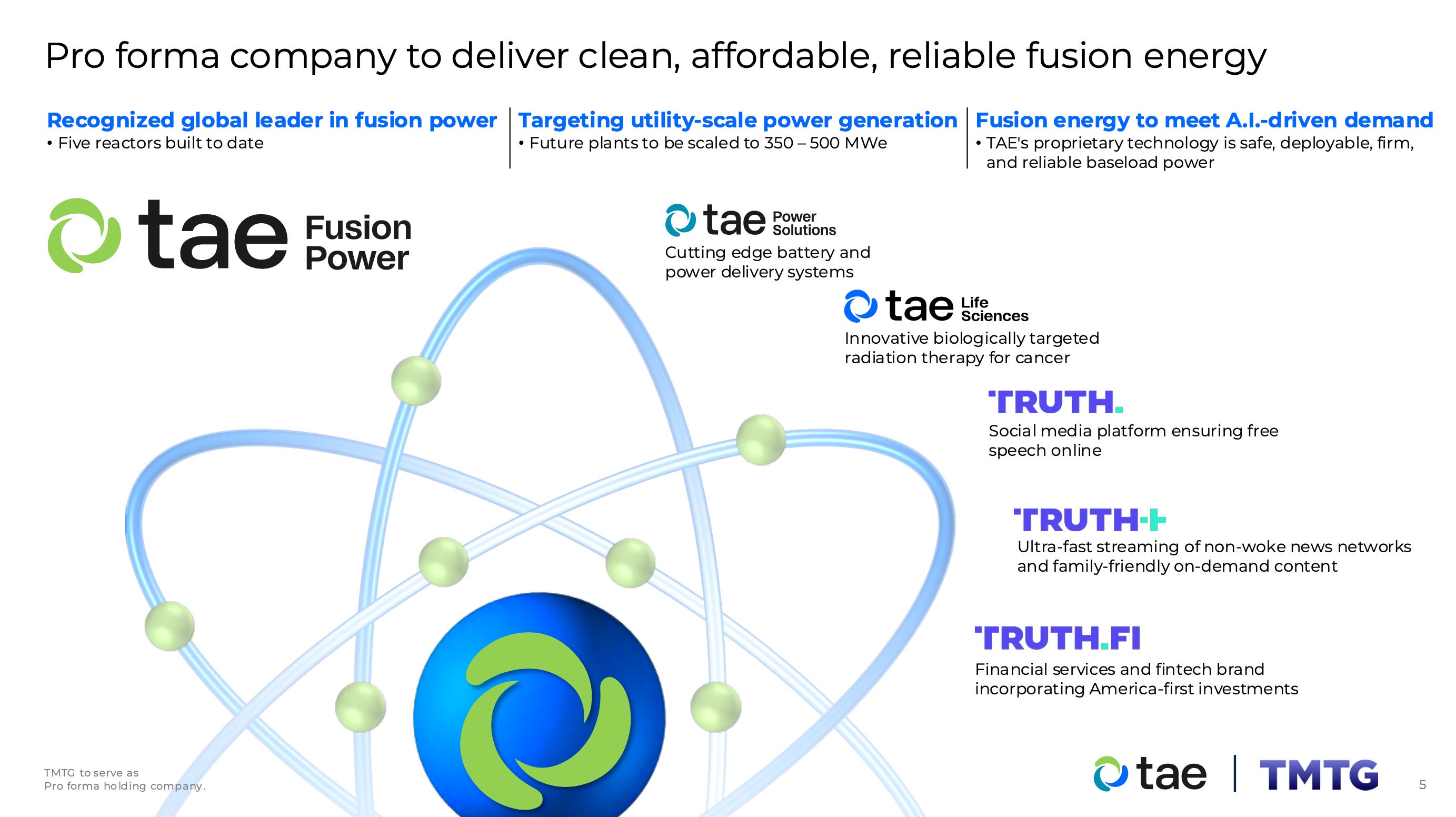
Let’s dispense with the silly notion that this is anything other than what it so obviously is. Although TAE Technologies boasts of having built “five reactors to date,” these are laboratory demonstration projects, none of which have achieved net energy gain—that is, where the fusion energy output exceeds the power used to heat and sustain the plasma inside of which the fusion occurs.
As recently as mid-November, the company indicated its plan “to deliver commercial fusion by the early 2030s,” and yet the press release announcing the deal commits to the construction of a power plant beginning next year. Never mind that the thing that is actually meant to produce the power does not yet exist. Having seen this movie many times, “begin construction” generally means buying some land, getting some permits, and throwing up a few buildings. You, too, can begin construction of a fusion power plant, or anything else, for that matter.
For its part, Trump Media & Technology Group is little more than a publicly traded shell with the president’s name attached. The company has averaged less than $1 million in revenue per quarter in 2025, while incurring about $40 million in quarterly operating expenses over the same period. It does have ready access to US capital markets and sported a market cap of about $3 billion in the days before the merger announcement, although that figure is down considerably from the $10 billion it was valued at just prior to the 2024 presidential election.

We have no issue with the legal and ethical dimensions of this transaction—we take it at face value that all applicable laws and conflicts of interest guidelines will be followed, in letter if not in spirit. Instead, our lament is the damage this deal will do to the existing civilian nuclear power industry for what amounts to nothing in return. We have long argued that fusion is a fake solution to problems that essentially don’t exist, a notion that surprises many whose knowledge of nuclear energy is shaped by the thicket of propaganda that surrounds the subject.
If you’d like to make coherent counterarguments when that excited relative of yours waxes lyrical about fusion over the holiday, read on…