

“You win some, lose some, and wreck some.” – Dale Earnhardt
The big news in the climate wars this week is President Donald Trump’s gambit to deliver on a campaign promise to limit the federal government’s authority to regulate greenhouse gases. On Thursday, the Environmental Protection Agency (EPA) issued a final rule revoking the all-important “endangerment finding”—an Obama-era expansion of the EPA’s power that claims greenhouse gases endanger public health and welfare, the science behind which Trump now argues was dubious at best. Absent this critical link, much of the federal climate regulatory edifice collapses.
A thicket of legal filings objecting to the move is certain to clog the courts for years, at least until the Supreme Court weighs in on the matter, and a preponderance of legal experts think Trump’s reasoning will not survive judicial review, although we suspect most of the same experts surely expect that the tsunami of associated legal fees will thrive nicely.
While the ultimate impact of this latest battle remains to be seen, a contemporary and highly relevant measure of the stakes involved is playing out in the US capital of climate resistance: California. The state plays an outsized role in national politics for at least three critically important reasons. First, as the country’s largest economy, political decisions emanating from Sacramento regularly carry national ramifications. Second, the Golden State is furthest along in the progressive environmental game of Snakes and Ladders, and several other US states have all but outsourced climate rulemaking to it. Finally, California’s incumbent governor—the telegenic and smooth-talking Gavin Newsom—is arguably the front-runner to replace Trump as president come 2028.
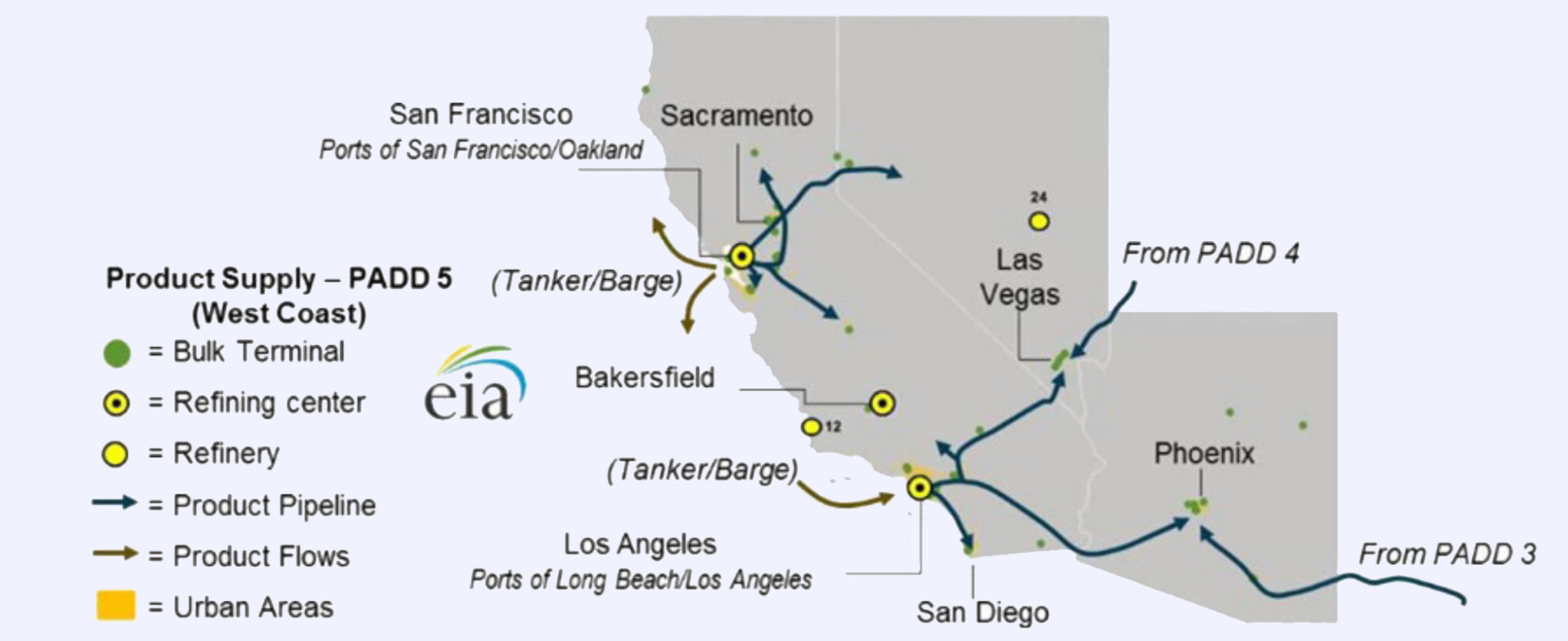
As we and many others have long documented, decades of aggressive regulatory harassment have left California’s hydrocarbon fuels industry teetering on the edge of a collapse that will shake the state’s economy to its core. To summarize briefly, California is effectively two fuel islands, one clustered around San Francisco and the other around Los Angeles. Neither half of the state is connected by inbound oil or refined product pipelines to the outside world, and links between north and south are skimpy. Northern California in particular faces an urgent crisis, as one of its few remaining petroleum refineries is shutting down, leaving the region largely unable to provide for its own gasoline, diesel, or jet fuel. Everybody sees the problem coming, and few doubt it’s just a matter of time before calamity strikes.
Perhaps recognizing the light at the end of the tunnel for what it was, Newsom spent much of 2025 trying to undo some of the damage he and his party had previously caused—if for no other reason than to extend-and-pretend the reckoning beyond his remaining time in office, which closes out in January 2027. When Valero announced the upcoming closure of its Benicia refinery, Newsom responded by negotiating directly with the company, exploring a possible transfer to another refiner, and using new market-stability tools to make continued operation more attractive. However, those efforts only secured a delayed, staged idling and import-terminal plan rather than long-term continued refining at the site.
As might have been anticipated, the non-linear nature of complex supply chains has recently imposed itself on the situation, and the Benicia wind-down has triggered a series of second- and third-order impacts that look certain to bring forward the day of double-digit-per-gallon fuels for consumers in the Bay Area and beyond. In the ultimate “we told you so” moment, industry insiders and outside experts alike are sounding the alarm, and the odds of a disorderly transition are skyrocketing. Let’s head to the Pacific Coast for an update.