
Party Pooper
The balloons will be the first to go.

“When things get too heavy, just call me helium, the lightest known gas to man.” – Jimi Hendrix
Among the chemical elements made scarce by the closure of the Strait of Hormuz, helium certainly has the most interesting properties. Because its electronic shell is so stable, it is practically impossible to force helium to react with anything. Helium doesn’t even interact with itself in any meaningful way and must be cooled to -269°C, just four degrees above absolute zero, before it becomes a liquid. As it turns out, total non-reactivity is a rare and exceptional attribute useful across the economy, including in many high-end applications in the semiconductor and medical industries.
Because of its association with methane in geologic structures, helium is produced on an industrial scale exclusively by stripping it from natural gas streams. Since the US is blessed with a few large fields with exceptionally high helium levels and because the gas finds application in advanced missile technologies, America has dominated its production for decades. Until recently, the country even held a large inventory of the gas in a national strategic reserve.

At first blush, the rise of liquefied natural gas (LNG) export facilities would seem bullish for helium supply. After all, chilling methane produces boil-off gas with elevated concentrations of inert byproducts like helium, so much of the work involved in separation is already done. However, given the low concentration of helium in most feed gases and the sleepy nature of a market dominated by the US government, investing incremental capital to recover helium seemed unwise. Helium atoms that entered LNG facilities eventually found their way to the atmosphere, where their extreme lightness means they ultimately escape the Earth’s gravitational pull and disappear into the vastness of space.
This changed with the development of Qatar’s massive Ras Laffan LNG export facility. Although Qatar’s feed gas contains only modestly high levels of helium—the company pegs it at just 0.04%, or 400 parts per million (ppm)—the sheer number of LNG trains concentrated at one facility and the opportunity to design helium recovery assets into their original construction made the opportunity compelling. By 2025, Qatar was the second-largest helium producer in the world, holding roughly a third of global market share.
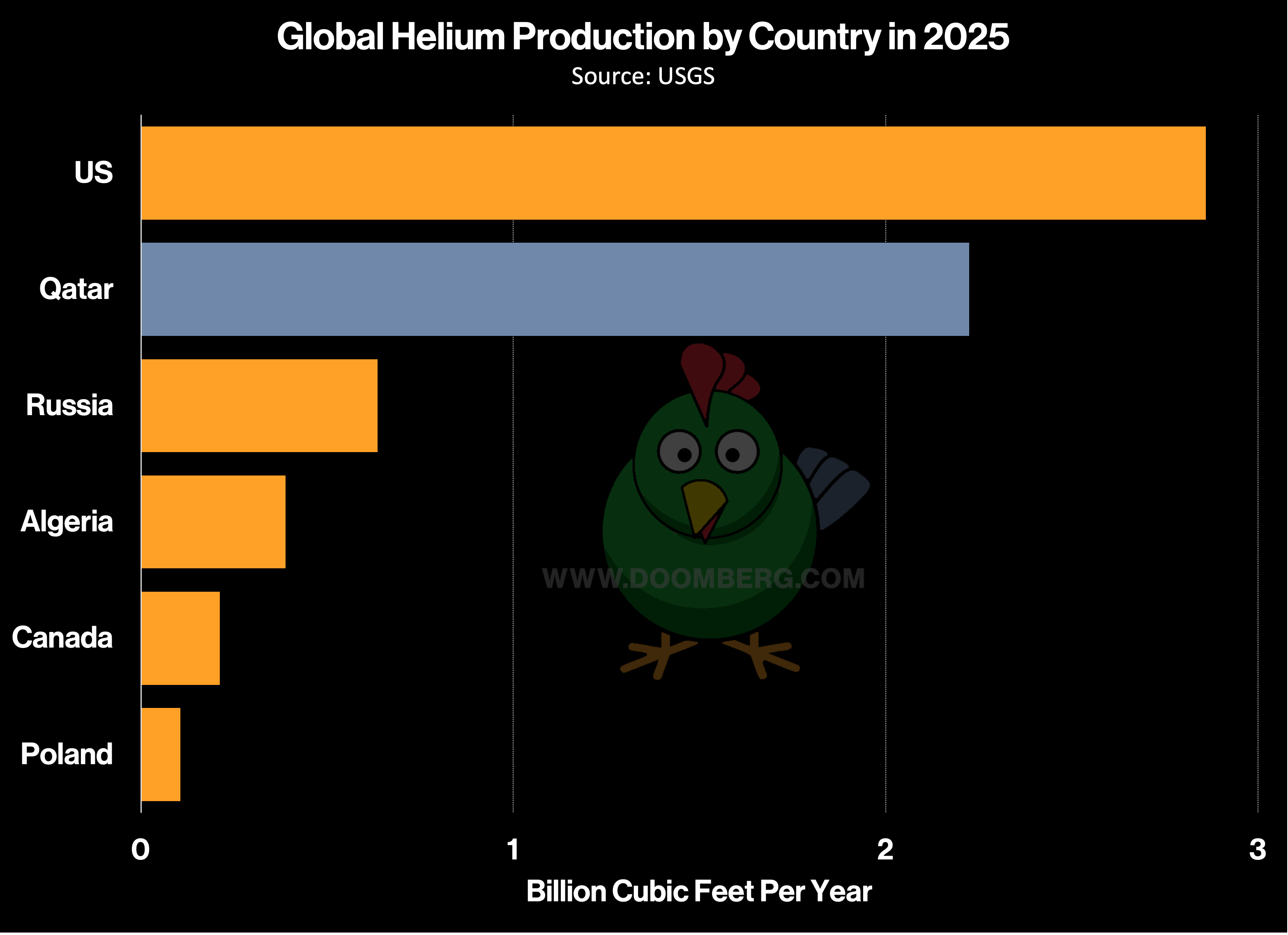
The success of Qatar’s investment evolved into a point source of industrial risk when war broke out in the Middle East. Iran’s early attacks on the Ras Laffan facility led to its closure, and the subsequent destruction of two of its 14 LNG export trains turned a temporary disruption into a true global emergency. These events unfolded into the teeth of the artificial intelligence (AI) boom, which was already tightening helium supplies and firming prices before hostilities erupted.
Like other commodities made short by the war, helium prices have exploded higher, demand has been rationed to the highest-value applications, and investors have been circling to deploy capital and potentially alleviate the crisis. Previously obscure helium plays have been thrown into prominence, with exposure to the gas seen as a bullish tailwind for equity markets. What are the likely medium- and long-term impacts of the current helium crisis? How fast can alternative supplies be brought online? Will a sustained helium shortage pop the stock balloon? Let’s survey the party store and find out.