
Silent Allies
The oddly muted response from Putin and Xi to Trump’s Venezuela play.

“What you do in this world is a matter of no consequence. The question is what can you make people believe you have done.” – Arthur Conan Doyle, “A Study in Scarlet”
Beginning in December of 1892 and continuing monthly into the following year, Sir Arthur Conan Doyle published short stories in The Strand Magazine featuring Sherlock Holmes, his wildly popular detective character. Already a smashing commercial success, Doyle’s spellbinding tales of detective work highlighted Holmes’ capacity for lateral thinking, pattern matching, deductive reasoning, and inversion.
The first of these stories, “The Adventure of Silver Blaze,” tells the tale of a missing racehorse and the murder of its trainer, John Straker, on the eve of an important race. Suspicion initially falls on a bookmaker, but Holmes systematically rules him out as the culprit through careful evaluation of the evidence. The case turns instead on the type of observation that made the Holmes character so popular: While interviewing numerous witnesses, Holmes finds it curious that none mentioned hearing the guard dog bark when the murder allegedly went down, something it surely would have done had a stranger committed the crime. This narrows the suspect list significantly, and the story takes several unexpected twists from there.

That the absence of evidence is itself a form of evidence was popularized by that story, and the phrase “dog that didn’t bark” remains firmly entrenched in the Western lexicon more than 130 years later, a testament to the power of literature to influence culture.
Over the past several months, as US President Donald Trump has directed his country’s navy to assemble off the coast of Venezuela and signaled his desire to depose President Nicolás Maduro, we’ve been pondering the meaning behind the relative silence of Russia and China. Both are ostensibly strong allies of Maduro and share significant interests in Venezuela, yet neither has barked to any great extent beyond perfunctory diplomatic protests.
Consider Russia and its president, Vladimir Putin. Despite the controversial nature of Venezuela’s most recent election, Russia was quick to recognize Maduro as the country’s legitimate leader and pledged to maintain a longstanding “comprehensive strategic partnership” across political, military, and energy domains. Russian state energy firms hold joint-venture stakes in Venezuela’s most prolific oil fields, and Venezuela, in turn, is a large customer of Russian arms.
Or take China, which in recent years has upgraded its relationship with Venezuela from a “strategic partnership” to a “comprehensive strategic partnership,” and now an “all-weather strategic partnership.” We are as lost as you probably are as to what those words actually mean, but, at least superficially, they appear to imply an ever-warming relationship. China is Venezuela’s largest customer for its oil exports, receiving around 400,000 barrels per day (bpd) thus far in 2025. The US takes most of the rest.
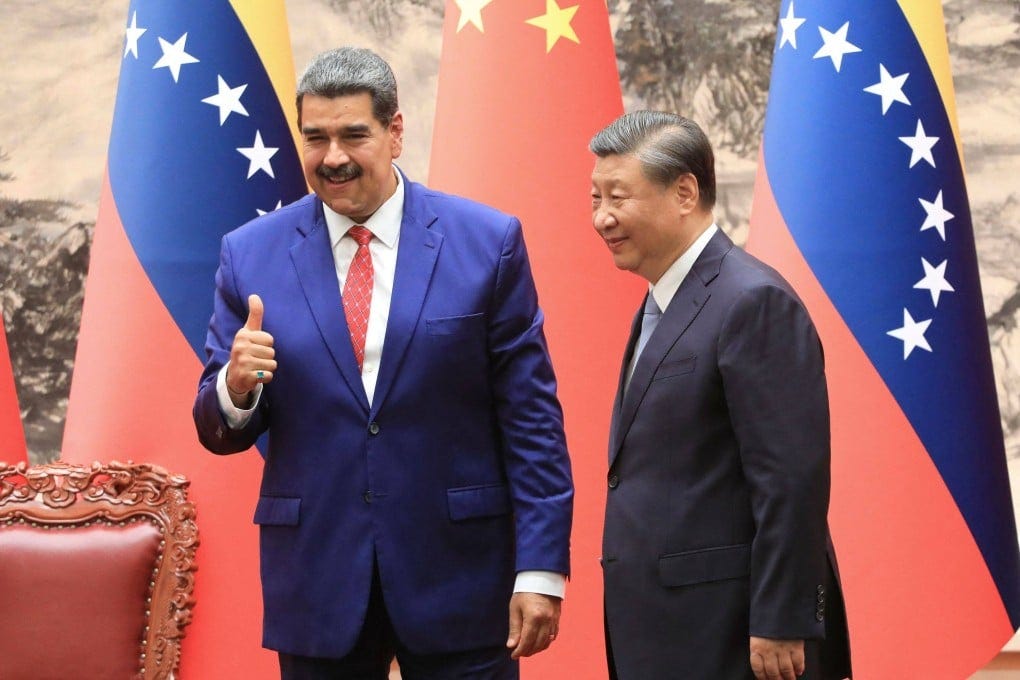
Given the stakes involved, we find the respective responses of America’s two most important geopolitical foes to be a real three-pipe problem. In fact, the entire Venezuelan situation is a bit of a mystery to us—a classic example of a geopolitical event that is almost certainly being misreported by the legacy media. Using the silent dogs as a clue, we have spent the past week applying lateral thinking techniques to the problem and have come up with five possible explanations for the observable facts. These range from the conventional to the highly speculative, at least until you take a closer look. Let’s explore each in turn, and in that order.