

“If Brazil depends only on Neymar, there will be a problem with Brazil, not with Neymar.” – Tite
Over 100 million years ago, South America and Africa began to drift apart, and in the narrow seas between them, thick layers of rock and salt gradually accumulated along what are now the coasts of Brazil and West Africa. Buried beneath those layers is an enormous amount of oil, with Brazil’s pre-salt resource commonly estimated in the tens of billions of barrels. Similar formations exist in the waters of Angola, Congo, and Gabon.
Although geologists long suspected it contained a large energy bounty, Brazil’s pre-salt was historically difficult to drill because it behaves like a slow-moving, plastic material that flows and squeezes around the wellbore, constantly threatening its stability and integrity. After years of intense investment by Petrobras and its international partners, sufficient technological advances were made, and the company estimates the breakeven cost of production from such formations at $30–40 per barrel. The oil majors are nothing if not deflationary machines.
The breakthroughs have catapulted Brazil into the largest oil producer in South America and among the top ten in the world. According to the Brazilian National Agency of Petroleum, Natural Gas and Biofuels (ANP), the country’s production recently surpassed 4 million barrels per day (bpd). If the current growth trajectory continues, it won’t be long before Brazil passes Iran on the leaderboard:
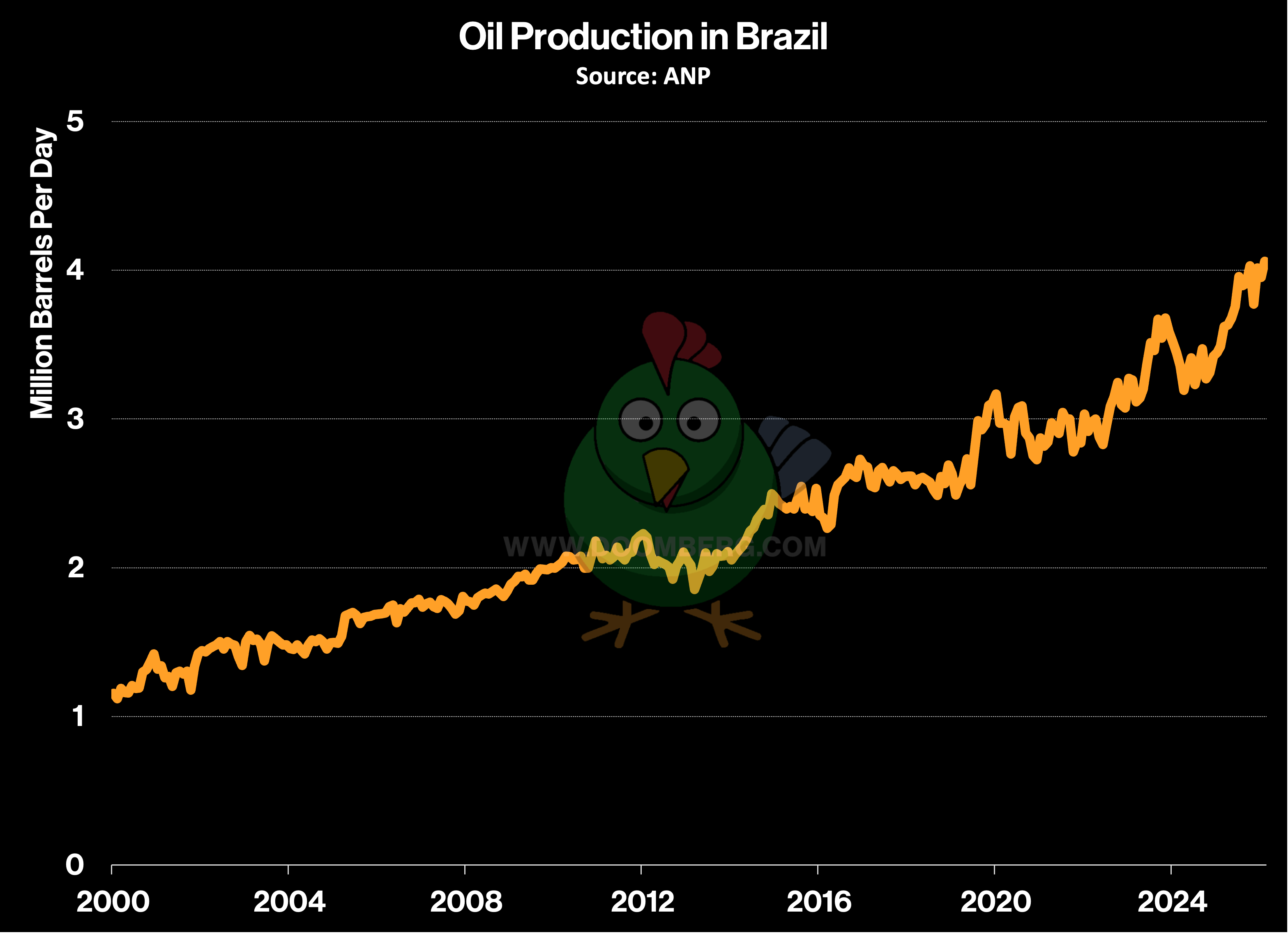
Adding to the importance of Brazil’s oil growth trajectory is the fact that the country has historically consumed only about 2.5 million bpd of the stuff, meaning each incremental barrel is available for export—all the more precious in the aftermath of the closure of the Strait of Hormuz. Anyone with spare production capacity profits handsomely from the resulting spike in prices.
While the economic benefits of being a global top-ten oil exporter are obvious, the associated risks were laid bare when the US military removed former Venezuelan President Nicolás Maduro and waged a pre-emptive war on Iran. The cover story for these operations may have involved, respectively, drug cartels and the well-worn “weapons of mass destruction” trope, but it would be naïve not to consider what is actually going on.
The fact that Brazil is the “B” in BRICS, and that one of our operating mental models sees the US immersed in World War III against all who support the main mission of that organization, means it’s time to speculate on the odds of a major hot war in the Western Hemisphere. When the totality of the evidence we are about to present is considered, there can only be one conclusion: The risk of a military conflict between the US and Brazil is far higher than most geopolitical analysts and political strategists are currently gaming. Let’s lay out the case.