
Sovereign Arbitrage
Heads, America wins; tails, Canada loses.

“You have to be prepared to take a spill.” – Shaun White
Just after midnight on March 24, 1989, the helmsman of the Exxon Valdez made a fateful error. In an attempt to avoid ice while navigating Alaska’s Prince William Sound, he accidentally ran the tanker aground on Bligh Reef. The maneuver ruptured eight of the ship’s eleven cargo tanks, spilling some 11,000,000 gallons of oil into the surrounding environment. (The attentive reader might wonder why 260,000 barrels or 37,000 tonnes aren’t the more widely quoted figures for this memorialized disaster, to which we would say the legacy media would quote oil spills in ounces if they thought they could get away with it.)
As tanker spills go, the Valdez was nowhere near the largest, but its impact on the oil industry was unparalleled. The outrage that followed led to a complete overhaul of how oil shipping operates, and the industry invested huge sums to improve tanker construction, port safety, and other related operations and monitoring logistics. Most notably, the use of single-hulled tankers was phased out altogether, replaced with double-hulled variants designed to be far more difficult to breach.
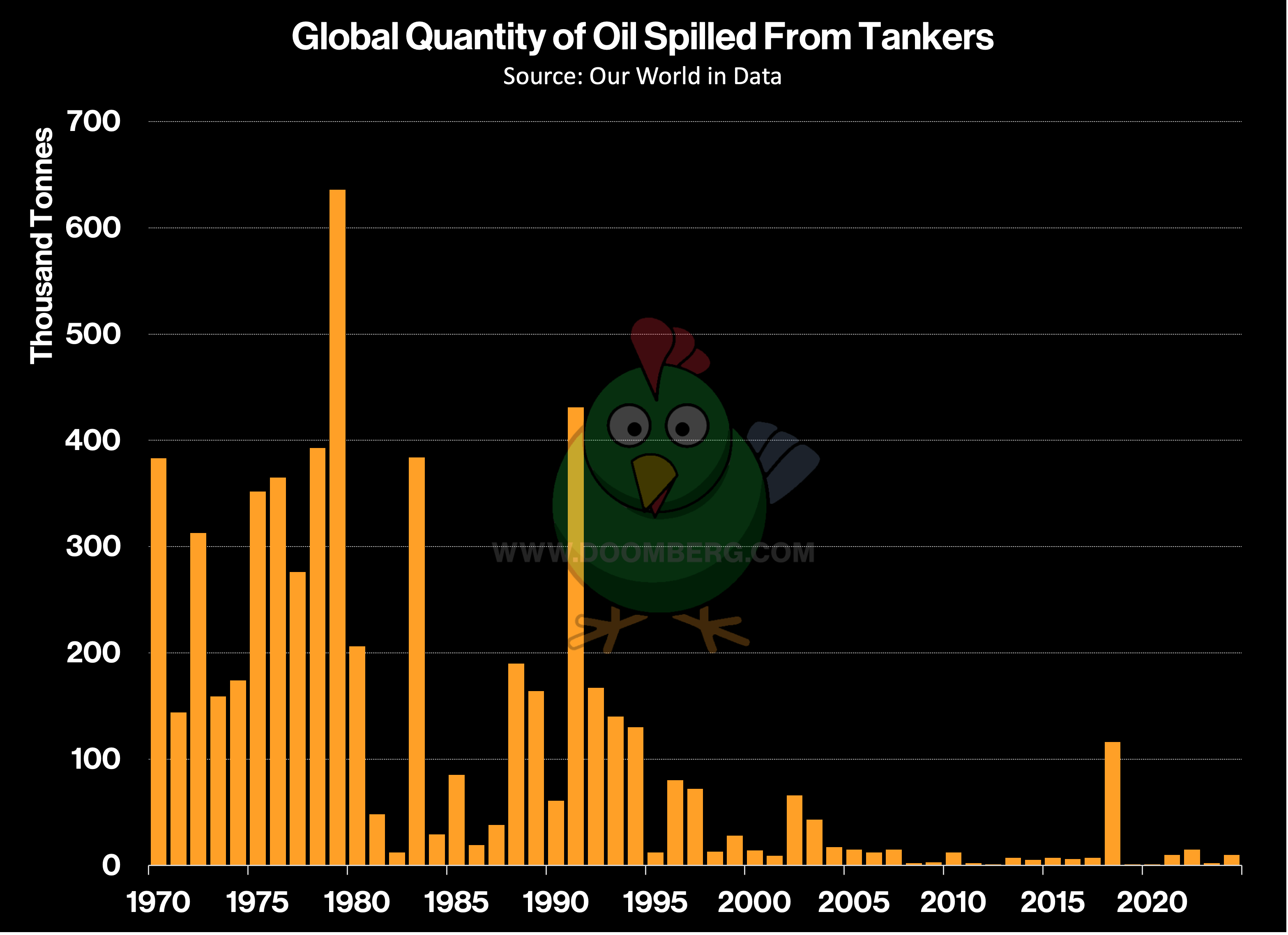
Once new targets are set for the oil and gas industry, they tend to be achieved, and the decades after Valdez have seen a remarkable drop in tanker-related spills. While it was not unusual to experience hundreds of thousands of tonnes of oil spilled annually in the 1970s and 80s, the 2020s have averaged less than 10,000. In particular, double-hulled Very Large Crude Carriers (VLCCs)—leviathans that can handle upwards of 2 million barrels of oil at a time—have performed exceptionally well, with no major spills on record. Let’s hope we didn’t just jinx them.
Rare though large spills may be, zero remains an emotional construct, as no risk can be wholly eliminated. Even zero is never quite zero, as one can’t be 100% assured it will remain zero in the future, the future being infinite and unfalsifiable. Environmental groups regularly exploit the asymptotic nature of a line that might approach zero but can’t ever get there, and the Exxon Valdez affair still finds its way into many contemporary advocacy campaigns.
One such campaign unfolded in Canada nearly a decade ago, with far-reaching consequences that are now causing pain too sharp to ignore. Political action inspired by the ghosts of oil-covered birds, otters, and sea lions has cost Canada’s energy sector billions in lost profits, enriched its American neighbors by the difference, and stunted its geopolitical power—even as the war in Iran creates unprecedented demand for what the country could currently be offering. It’s no exaggeration to say the fallout for the Canadian economy risks national unity, adding momentum to separatist movements in the Western provinces. With a fresh move afoot in Ottawa to undo the damage, and given the stakes involved, it’s time to assess where the political puck is headed next.