

“Sundown in the Paris of the prairies
Wheat Kings have all treasures buried” – Gord Downie, “Wheat Kings”
Approximately 400 million years ago, what is now the Canadian province of Saskatchewan lay near the equator. The crust in that area was slowly sinking, creating a broad, shallow sedimentary basin known today as the Elk Point Seaway. Ocean water repeatedly flooded into these lowlands, and the basin slowly turned into a giant, warm, slowly evaporating bathtub. Dissolved seawater salts became increasingly concentrated and began to crystallize, settling on the seafloor in thick layers.
As the process repeated itself for 5 million years or so, the Prairie Evaporite Formation eventually emerged—a uniquely thick, laterally extensive package of salts that are relatively flat and predictable in the subsurface. This makes them especially easy and cheap to mine at scale.
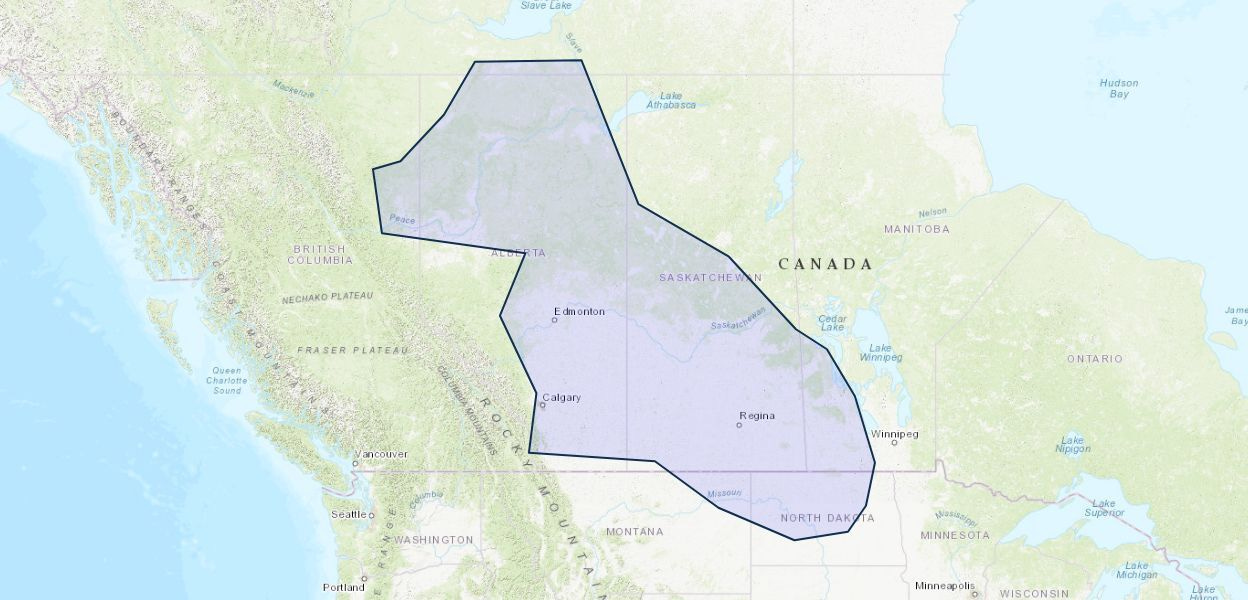
In certain parts of this formation, potassium (K) exists in high concentrations, with measurements ranging from 11% to 18% on an oxide equivalent (i.e., K₂O) basis. Along with nitrogen (N) and phosphorus (P), potassium is a critical fertilizer used in modern farming, part of the N-P-K blend ubiquitous to the agricultural trade. Purified potassium chloride (KCl) is commercially known as potash, a throwback to when the metal was leached from wood ashes and evaporated in large iron pots.
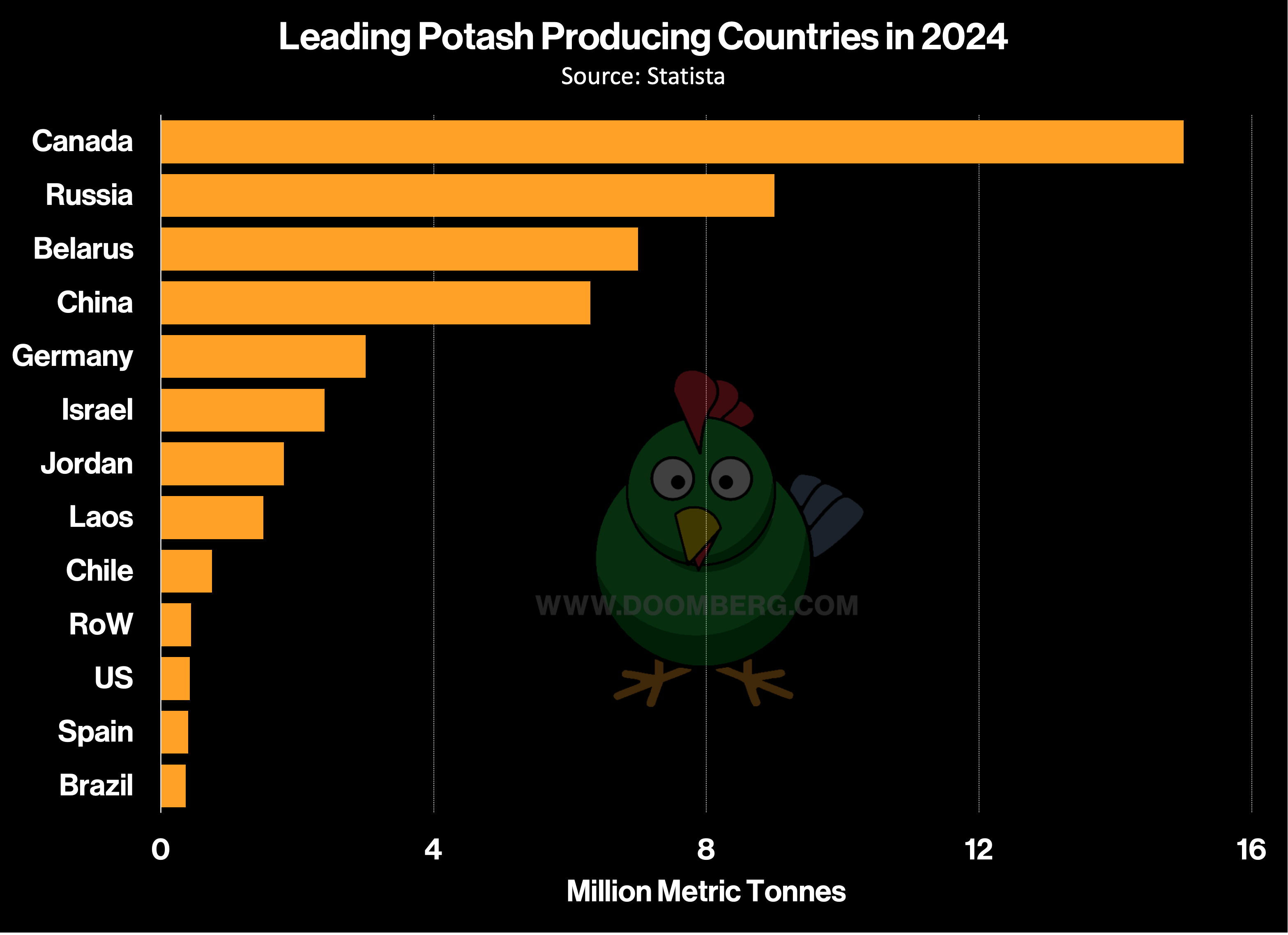
To say that Saskatchewan is the undisputed global leader in potash production would be an understatement. The Prairie Evaporite Formation is estimated to hold hundreds of billions of tons of K₂O equivalent as an in-place resource, and proven recoverable reserves are often estimated at 100 billion tons of ore. This compares to global annual potash consumption of about 48 million tons, of which Saskatchewan alone accounts for roughly one third. The US relies on imports for about 90% of its potash consumption, the vast majority of which originate in the Canadian province.
With US unipolar hegemony at the end of an era, and the onset of a more chaotic period of early-stage multipolarity, the rules-based order that has persisted since the end of the Second World War is being scrambled. As Russia grows ever more powerful in Europe, and China asserts escalation dominance in Asia, US President Donald Trump is predictably turning his attention to the Western Hemisphere, executing what a recent national security strategy document called the “Trump corollary” to the Monroe Doctrine.
In his signature style, Trump isn’t letting pesky constraints like international norms mask the raw power moves he intends to execute during the remainder of his term. Whether referring to Canada as the “51st state,” renaming the Department of Defense to the Department of War, insisting that the US must “take” Greenland for national security reasons, or surrounding Venezuela with the largest armada of warships the Caribbean has seen since the Cuban Missile Crisis, Trump is signaling a new era of muscular foreign policy in America’s backyard.
Legalities aside, as the geopolitical chess pieces are being reconfigured, it behooves the agnostic analyst to ponder all possibilities, and Saskatchewan would seem an ideal candidate for Trump’s voracious appetite. With a geographic area on par with Texas but a population barely north of a million, the province is one of the most resource-rich and sparsely populated areas on earth. It might not have been on your radar previously, so let’s put it there now.