
Project Turtle
As worst-case scenarios rapidly unfold, will the US move to protect home base?

“I jumped on the grenade that was thrown at myself and my friend. I don’t recommend it.” – Kyle Carpenter, Medal of Honor recipient.
Sometimes it’s best to just stick with your first instinct.
When the war with Iran first broke out, we were—quite naturally—horrified. Regardless of our views on the justification for the joint US-Israeli preemptive attack, a full-blown kinetic conflict in the beating heart of global oil and gas markets was always going to be fraught with enormous risk. In the days after the first missiles were exchanged, we posted a series of articles that outlined what market indicators to keep an eye on, what moves US President Donald Trump might make to protect US consumers, and even the most important question on the board for those gaming the odds of escalation:
Is Iran still firing advanced missiles and drones in large numbers?
Despite consistent evidence in the affirmative, two weeks of war produced what we considered to be a relatively docile response by energy markets, with benchmark oil prices hovering close to—or even under—$100 a barrel. This prompted us to reevaluate our own assumptions and consider whether the price action might be justified, thoughts we shared openly with our subscribers in our last piece.
On Wednesday, any pretense of a reasonable off-ramp took a serious beating when news crossed the wires that Israel had bombed Iran’s South Pars gas field, the enormous hydrocarbon accumulation the country shares with Qatar. Given our recent insight into how Iran’s leaders would likely respond—thanks in no small part to our newly curated list of pro-Iranian Twitter/X feeds—we knew the following catastrophe would swiftly follow:
“A Qatari complex housing the world’s largest liquefied natural gas export plant suffered ‘extensive damage’ after a missile strike, hours after Iran threatened energy facilities across the Persian Gulf.
The Ras Laffan Industrial City was hit by an Iranian missile after four others were intercepted, authorities said late Wednesday. The site hosts facilities including the LNG plant, which typically accounts for about a fifth of global supply. Production there was already halted after an Iranian drone attack earlier this month.
The incident marks yet another escalation in hostilities in the region and follows a string of attacks targeting oil and gas infrastructure in recent days.”
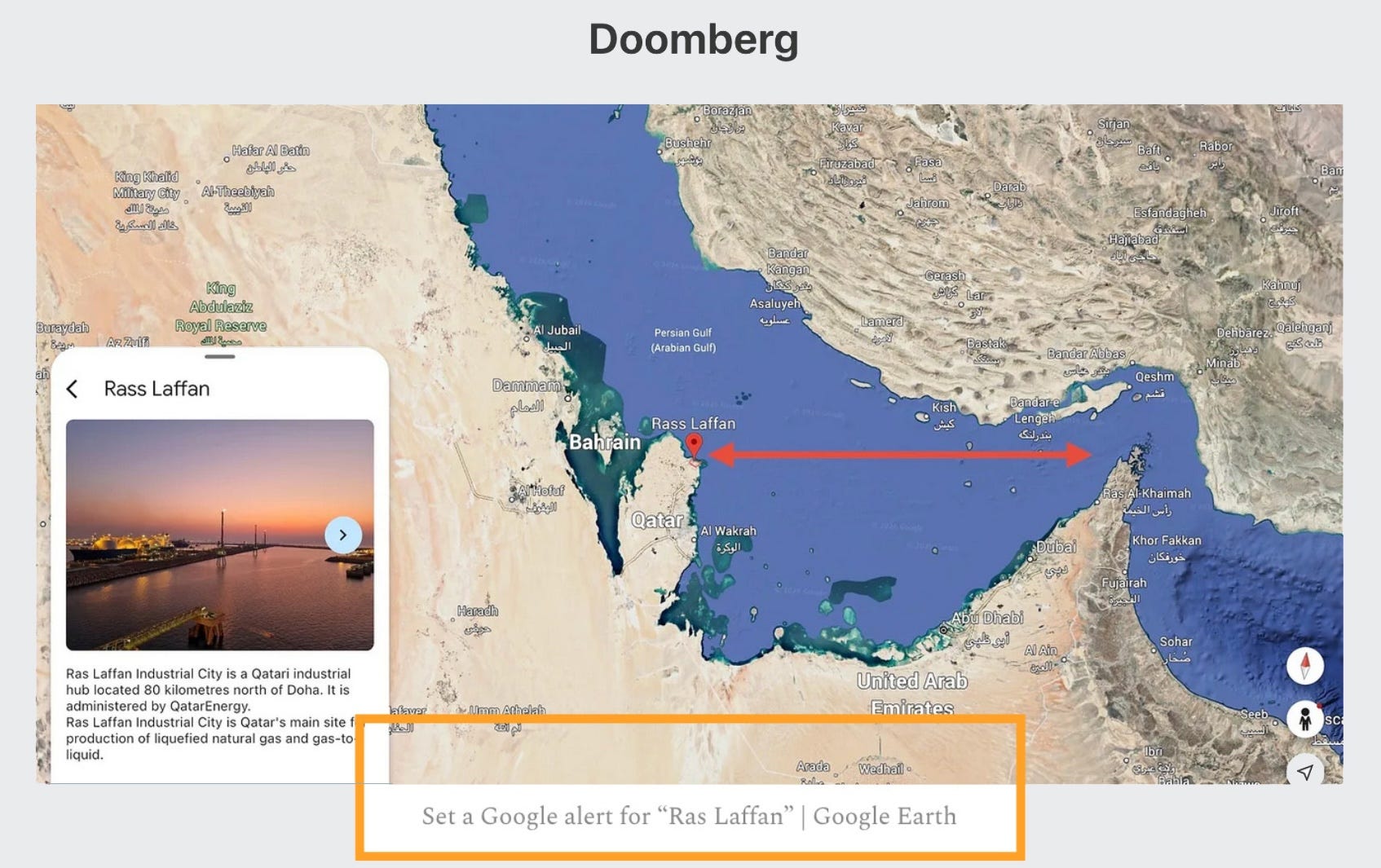
While damage assessments continue, QatarEnergy has confirmed that both a gas-to-liquids facility operated by Shell and its LNG trains were hit and suffered significant damage. Good luck to the European Union as it works to refill its depleted natural gas stocks ahead of the upcoming winter.
It is difficult to imagine how the escalator halts its relentless ascent now—Trump’s belated attempt to put the pin back in the grenade notwithstanding. The Strait of Hormuz is unlikely to be opened anytime soon, oil and gas facilities across the region are now considered fair game by both sides, and the rest of the world had better prepare accordingly.
Shocked back to the reality of just how bad things could get, we took another look at an earlier musing we posted nearly two weeks ago on Substack’s Notes. In it, we expressed a conjecture that feels real enough to ponder in full now:
So, is Fortress North America really in the offing? A full accounting of the relevant molecular distribution across Canada and the US makes it far more likely than most can conceive today. Let’s explore the numbers and ponder the consequences.